The Spare-Storage Trap: When Keeping Everything Makes Things Harder to Find
The spare-storage trap turns empty cupboards into clutter magnets. Sort belongings by actual use before assigning them a home, so needed things are easier to find.
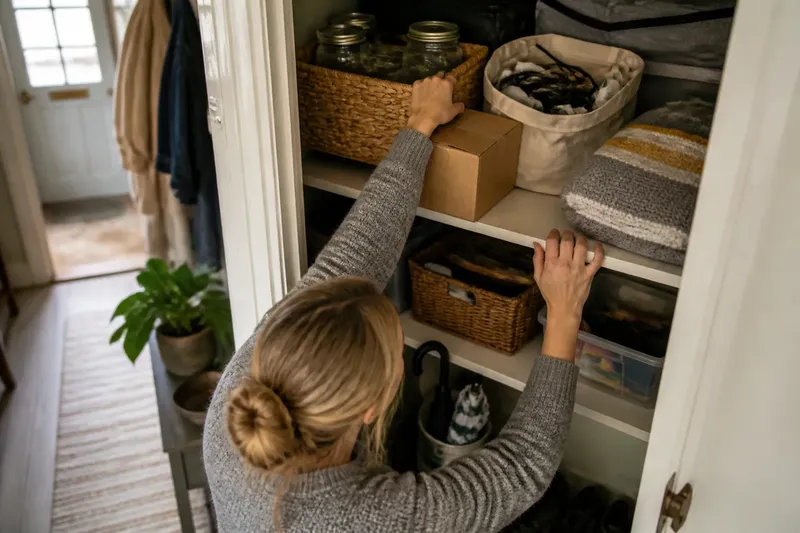
You open the hall cupboard for the umbrella and have to move a box of spare jars, a tote bag of old cables and a folded blanket first. The umbrella is there, somewhere. This is the spare-storage trap: treating every empty shelf as an invitation to keep something, rather than asking whether the item deserves a place in the household at all.
Unused space can be useful, but filling it is not a purpose in itself. Before assigning belongings a home, sort them by how they are actually used: often, seasonally, rarely or not at all. That order makes storage a response to household life, rather than a reason to hold on to things that have become difficult to locate, maintain or let go.
1. What does the empty space need to do?
A bare shelf is not a failed shelf. It may be useful as room to put down a parcel, space to reach a coat without shifting other things, or a little breathing room for belongings already stored there. The value of a cupboard is not measured by how much it can contain.
Start by looking at the space itself. Is it awkward to reach? Damp or dusty? Near the front door, or tucked under the stairs? These details affect what belongs there. A deep, high shelf may suit a labelled box opened occasionally; it is a poor home for the keys you need on the way out.
It is not worth buying matching baskets simply to make a half-empty cupboard look finished. Containers can help with a defined group of belongings, but they also occupy space and conceal what is inside. Decide what the storage must do before choosing a container.
2. Which things earn a place through use?
Gather belongings by purpose before sorting them into cupboards. Put together the items used for shoe care, for instance, rather than keeping polish near the coats, brushes in a bedroom drawer and spare laces in a sewing tin. A group is easier to judge when its members can be seen at once.
Then ask how each item serves the household now. “I might need it” is not the same as “I use it for this”. Consider whether another object already does the job, whether the item works, and whether anyone knows how to find it. A spare can be sensible when it is a useful replacement; several forgotten versions of the same tool may simply make the useful one harder to reach.
Imagine a household with a box of mismatched mugs on a high kitchen shelf, although the same people use the same few mugs each day. They could check which extras are clean, intact and wanted, set aside any that have a real use, and pass on the remainder. The observable result would be a shelf where the everyday mugs are easier to see and the retained spares have a defined purpose, rather than an unexplained claim on space.
3. How should you sort by actual use?
Use a few plain categories. They are not rules about how much a household may own; they are prompts to distinguish a working item from an item kept by inertia.
- Used often: Keep it close to where the task happens, in a place you can reach without unpacking other belongings.
- Used in a season or on an occasion: Keep it if the occasion still belongs to your life, and store it with related items or the things needed to use it.
- Kept as a spare: Name what it replaces and where the working version is. If that purpose is vague, reconsider the spare.
- Uncertain: Put it aside briefly and note what would prompt you to use it. A clear, likely occasion is different from a general feeling that it may come in handy.
- Unused, unwanted or no longer useful: Decide whether it can be passed on, recycled or disposed of appropriately, instead of moving it to another cupboard.
For an uncertain item, avoid creating a permanent “maybe” box without a way to revisit it. A note on the container can record the question: does anyone in the household use this, or is there a particular occasion for keeping it? Once the household has considered that question, make a decision rather than adding another layer of storage around the indecision.
4. Where should each group live?
After sorting comes placement. Put frequently used belongings where the relevant task happens: cleaning cloths near the cleaning supplies, for example, or spare batteries in the household drawer where people look for them. This is not a call to fill every nearby gap. Leave enough room to take an item out and return it without disturbing its neighbours.
For occasional belongings, use a location that is accessible enough for the occasions they serve. A cake tin used for family gatherings might belong with baking equipment, while a decorative wreath brought out for a particular season could share a labelled box with its hooks. Grouping by use gives an item context when it is found again.
Resist storing things solely because they fit. A narrow gap beside a water pipe may accept a stack of folded bags, but that does not make it a good place for them if retrieving one means pulling out the whole stack. Keep household access and the space’s actual conditions in mind; for anything affected by specific care requirements, follow the item’s label or manufacturer’s instructions.
5. What should happen to uncertain and duplicate belongings?
Duplicates deserve a closer look, not an automatic purge. A second set of sheets may be useful while the first is being washed; an extra screwdriver may serve a different household task. The question is whether the duplicate has a recognisable job, not whether it is identical to another object.
For things with no clear role, consider the cost of keeping them in attention as well as in space. You may have to move them, remember where they are and inspect them when searching for something else. A box that has not been opened for years is not proof that its contents are useless, but it is a reason to find out what is in it and decide item by item.
If an object belongs to another person in the household, include them in the decision. Shared storage can turn an individual’s uncertainty into everyone else’s search problem. A calm conversation about the item’s purpose and possible destination is more useful than quietly shifting it to a different shelf.
6. What questions help with the spare-storage trap?
Should every empty shelf stay empty?
No. A shelf can hold useful belongings, but it need not be filled to prove its value. Leave room where access, future use or ordinary household tasks make that space helpful.
How do I decide whether to keep a spare?
Identify what it replaces and the circumstances in which it would be used. If neither is clear, pause before giving it a permanent place among the household’s working belongings.
What if I cannot remember what is in a box?
Open it when you can make time to sort its contents, then label what remains in plain language. If the box contains mixed, unrelated items, separate them by use before choosing where they belong.
Can I use an attic, shed or garage for things I rarely use?
Possibly, if the conditions suit the belongings and you can retrieve them when needed. Check for damp, temperature changes, pests and access issues, and follow any care instructions for the items involved.
7. How can storage stay useful after the first sort?
Notice what happens during ordinary use. If you repeatedly move one thing to reach another, the order may not match the way the household works. If an item is regularly put back in a different place, its assigned home may be inconvenient, or the group may need to be sorted again.
Keep labels descriptive rather than aspirational: “shoe care” tells you more than “hall essentials”. For an opaque box, list the contents on the front if you are likely to forget them. For an open basket, a label may add little; the visible contents may already make its purpose clear.
When a new belonging arrives, ask which existing group it joins and whether that group still fits its space. This small pause keeps an empty cupboard from becoming the default answer to every object that has no assigned home. The spare-storage trap is easier to avoid when storage follows actual use, leaving useful belongings findable and unused space free to serve a purpose of its own.